
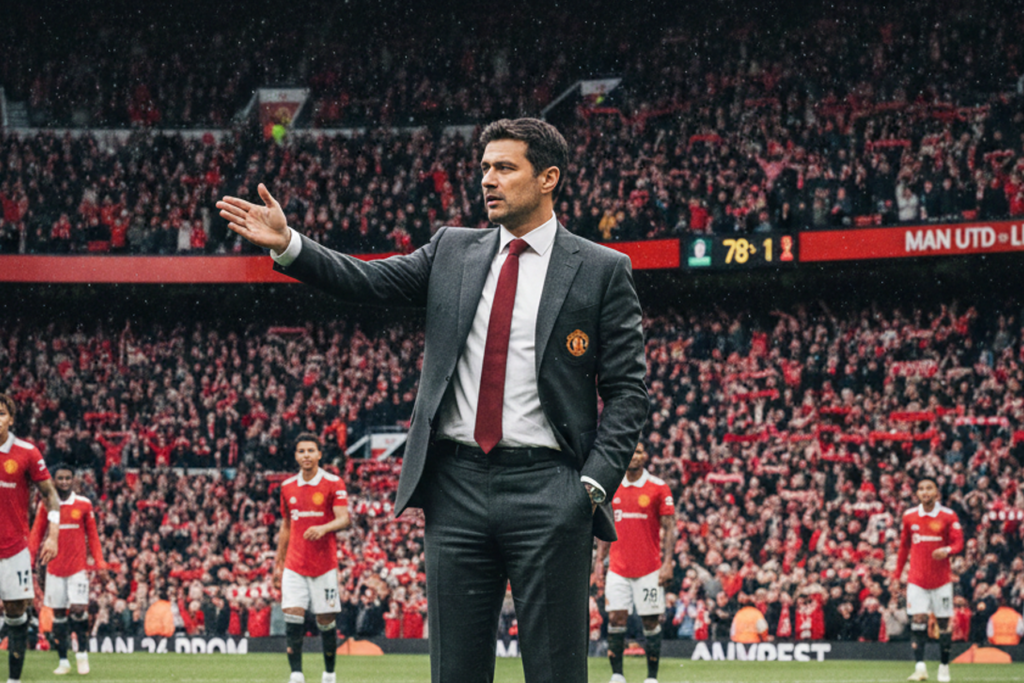
The search for a new permanent manager at Manchester United is, once again, underway. Following the departure of Ruben Amorim, the club finds itself at a familiar crossroads, evaluating a market filled with both established elite coaches and promising up-and-comers. Among the recurring names in this perpetual cycle, one stands out not for being the outright favourite, but for his enduring, almost destined link to the Old Trafford hot seat: Mauricio Pochettino. While candidates like Julian Nagelsmann, Thomas Tuchel, and Oliver Glasner dominate immediate speculation, Pochettino’s candidacy represents a compelling, if complex, strategic option—a true dark horse with a unique blend of Premier League pedigree, developmental philosophy, and unfinished business in England.
The Unfinished History Between Pochettino and United
The connection is neither new nor accidental. Pochettino’s name has been intertwined with Manchester United’s managerial deliberations for the better part of a decade. He was the frontrunner to replace José Mourinho in 2018, a possibility that reportedly unsettled Tottenham Hotspur’s hierarchy at the time. That opportunity went to Ole Gunnar Solskjaer. When Solskjaer’s tenure concluded, Pochettino was again a principal contender, locked in a direct head-to-head with Erik ten Hag. For the second time, the club looked elsewhere. This history creates a narrative of a mutual attraction that has never quite been consummated, suggesting a lingering belief within parts of the United structure that his profile remains an ideal fit.
Tactical Philosophy and Squad Alignment
Beyond history, the tactical argument for Pochettino is robust. His core philosophy—centered on high-intensity pressing, proactive possession, and rapid vertical transitions—aligns with the modern, front-foot football United’s leadership and fanbase desire. More importantly, it potentially suits the current squad’s attributes. Pochettino has a proven track record of developing young talent and improving players individually, as evidenced by his work at Southampton and Tottenham. A United squad containing a mix of high-potential youngsters and underperforming stars could benefit significantly from a coach renowned for man-management and tactical education. His systems are structured yet flexible, often built around a core 4-2-3-1 but adaptable to personnel, unlike the more rigid frameworks of some other candidates.
The World Cup Complication: Timing and Availability
The most significant practical hurdle to Pochettino’s immediate appointment is his current commitment as head coach of the United States Men’s National Team (USMNT), with the 2026 FIFA World Cup on home soil beginning in June. His contract is set to run through the tournament’s conclusion in July. This creates a clear logistical dilemma for United. If they seek a permanent manager before the 2026/27 season, waiting for Pochettino would mean a drastically shortened pre-season, with a new boss arriving just weeks before the campaign kicks off. This timeline may be untenable for a club needing a thorough summer rebuild. However, if United opt for a longer-term interim solution—a caretaker until next summer—Pochettino instantly becomes a far more viable candidate available on a free transfer post-World Cup.
Weighing the Field: How Pochettino Stacks Up Against Other Candidates
To understand Pochettino’s dark horse status, one must contextualize him within the wider candidate pool. Thomas Tuchel offers elite tactical acumen and a trophy-laden CV but comes with a reputation for club hierarchy clashes. Julian Nagelsmann represents a brilliant, modern tactical mind but is also tied to Germany’s World Cup campaign and carries questions about handling a dressing room of superstars. Unai Emery has performed miracles at Aston Villa but seems settled in a project where he has total control, something United may not replicate. In-house options like Kieran McKenna or Michael Carrick offer club DNA but lack top-level experience.
Pochettino sits intriguingly in the middle of this spectrum. He possesses more top-flight and Champions League experience than the up-and-coming coaches, yet presents a potentially more collaborative and long-term project-focused profile than the immediately available elite winners like Tuchel. He bridges the gap between proven developer and established name.
The Intangible Fit: Culture, Pressure, and Project Management
Manchester United is not just a football club; it’s an institution under a unique microscope. Pochettino’s experience in the Premier League, specifically at Tottenham—a club with similar global stature and intense media scrutiny—is invaluable. He understands the week-in, week-out pressures, the relentless news cycle, and the expectations of managing a giant. Furthermore, his stated desire to return to club management in England indicates a specific ambition that aligns with United’s vacancy. While his tenure at Chelsea ended without silverware, the late-season surge and development of players like Cole Palmer demonstrated his ability to stabilise and improve a squad in transition—a skill directly applicable to United’s current state.
Potential Obstacles and Counter-Arguments
No candidacy is without its drawbacks. Pochettino’s lack of a major league title in England is often cited, though his work in elevating Tottenham to consistent top-four finishes and a Champions League final is widely respected. Some critics point to his final season at Paris Saint-Germain or his Chelsea departure as evidence of unresolved tactical limitations at the very highest level. Additionally, the club’s recent pivot under INEOS towards a data-led, modern structure may see them favour a younger coach like Nagelsmann who epitomises that model, over Pochettino who, while modern, is from a slightly older cohort.
FAQ
Why is Mauricio Pochettino considered a candidate for Manchester United?
Pochettino is a candidate due to his extensive Premier League experience, proven ability to develop players and implement an attacking style, and a long-standing historical link to the club from previous managerial searches in 2018 and 2022.
What is the biggest challenge to appointing Pochettino right now?
His current contract as head coach of the United States national team, which runs through the 2026 FIFA World Cup (July 2026). This makes an immediate appointment before next season virtually impossible unless a deal is structured for a future date.
How does Pochettino’s tactical style suit Manchester United’s squad?
His high-pressing, possession-based football that emphasises youth development and rapid transitions could suit United’s mix of young talent and athletic players, potentially getting more from underperforming stars.
Has Pochettino ever won a major trophy in England?
No, he has not won a major trophy in England. His greatest achievement was leading Tottenham Hotspur to the UEFA Champions League final in 2019. He won domestic trophies in France with Paris Saint-Germain.
Who are Pochettino’s main competitors for the job?
Other serious contenders include Thomas Tuchel, Julian Nagelsmann, Oliver Glasner, and potentially in-house options like Michael Carrick or Kieran McKenna.
Would Pochettino be a “safe” appointment?
He would be considered a lower-risk appointment in terms of Premier League familiarity and man-management, but carries the perceived risk of a coach yet to win the biggest domestic prizes in England.
What did his spell at Chelsea reveal about his suitability?
His Chelsea tenure showed he could stabilise a chaotic project, improve individuals, and generate strong late-season form, but also ended without silverware and with questions over defensive consistency.
Is Pochettino interested in the Manchester United job?
While he has never publicly campaigned for it, his well-documented desire to return to top-level club management in England, combined with his past interviews for the role, strongly suggest he would be interested.
How does his candidacy compare to Thomas Tuchel’s?
Tuchel offers a more immediate guarantee of elite tactical structure and major trophy pedigree but with a reputation for conflict. Pochettino offers a potentially more sustainable project and player development focus, with slightly less proven top-tier success.
Could United wait for Pochettino until after the World Cup?
Yes, but it would require appointing a competent caretaker manager for the entire 2026/27 season, delaying the start of a permanent project—a significant strategic decision for the club’s hierarchy.
Verdict
Mauricio Pochettino’s candidacy for the Manchester United manager role is defined by compelling fit overshadowed by complex timing. He is not the flashiest name, nor the most decorated, but he represents a sophisticated and well-understood proposition: a manager capable of building a cohesive, attacking team while elevating a multi-generational squad. His perennial presence on United’s shortlist is a testament to the enduring appeal of his skill set. The central question for United’s decision-makers is whether the logistical hurdle of his World Cup commitment is outweighed by the promise of long-term stability and a return to a recognizable football identity. In a field of volatile geniuses and unproven talents, Pochettino remains the strategic dark horse—a candidate whose greatest strength may be his specific readiness for the unique and arduous project that awaits at Old Trafford, if the club is willing to navigate the waiting game.